A sermon from the Restoration
Movment.
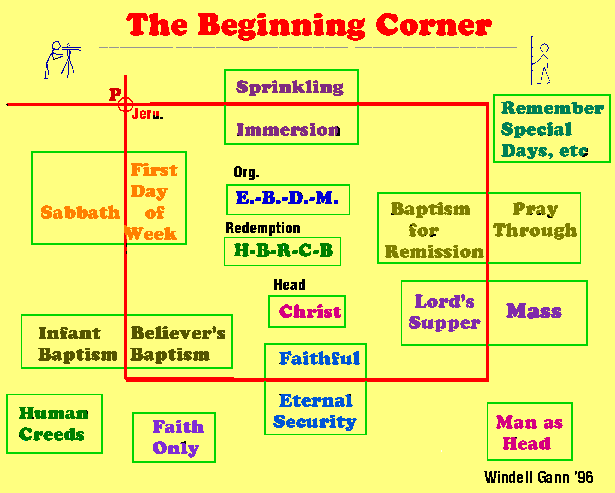
                       THE BEGINNING CORNER


1.   Immersion vs. Sprinkling


     a.   Word in the Greek is Baptidzo, "immersion"

          Rantidzo means "sprinkling"


     b.   But apart from study of the words, the usage tells us it

          is a burial.  Rom. 6:3-5; Col. 2:12.


     c.   Baptism ... water, much, water, going down into,

          coming up out of.


2.   Baptism for Remission of Sins, vs. Praying Through


     a.   Matt. 26:28 is // Acts 2:38 "eis"


     b.   Peter -- Acts 2:38; All cases of conversion in Acts.


     c.   Paul at Damascus.  Cornelius at Caesarea.


3.   Lord's Supper ... every first day vs. Irregular Time  (Mass)


     a.   Acts 20:7

          1 Cor. 11

          1 Cor. 16:1-2


     b.   No historian will dispute the fact.

          Modern man has conceived this idea change-- and that

          its observance is better than the Lord's plan and the

          first church of Christ.


4.   Faithful vs. Eternal Security


     a.   Revelation 2:10 "Be faithful"

          1)   "Take heed, lest ye fall."

          2)   James 5:19-20


     b.   Notice also the parables of the Lord.


     c.   The thought that once saved always saved.

          1)   1 Cor. 9:27;   Gal. 6:9


5.   Baptism if Believers   V.s. Infant Baptism

     (Acts 16:15, 33)


     a.   Is taken today that when a "household" is mentioned it

          included infants.  But cannot show first that any such

          households included infants.


     b.   Second, the Lord set down the rule that candidates for

          baptism must be believers.  Mark 16:15.


     c.   Consider those on Pentecost-- Acts 2


     d.   Based on false doctrine that children are sinners from

          conception.


6.   First Day of the Week   vs.  Sabbath.


     a.   Jesus arose on first day of the week.  Mark. 16:9


          1)   Some deny that was the day Christ arose.

               (Sabbath)


     b.   Some say we should keep the Sabbath of the Old

          Testament.


     c.   Others erroneously say the Sabbath has been changed,

          that Sunday is the Christian Sabbath.


     d.   That Christ arose, the day is the significance of our

          day of worship.  The prominence of the Resurrection--

          that is our hope of atonement, and hope of eternal life

          with God.


          1)   Church founded on that Day.


          2)   Early disciples worshiped on that day (Galatians

               and Corinthians did, 1 Cor. 16.   The Troas

               church did , Acts 20:7.


     e.   All of the early historians substantiate this fact.


     f.   Some try to show that Paul worshiped on the Sabbath

          from the fact that he met with the Jews in the

          synagogues everywhere he went.


7.   Faith Only V.s..  The Plan of Salvation.


     a.   John 3:16.  vs. other scriptures.


          1)   Method of interpretation -- Totality of Scriptures

               "Rich Young Ruler"

               a)   Matt. 19:20 -- "young"

               b)   Mark. 10:22 -- "rich"

               c)   Luke 18:18  -- "ruler"


     b.   "All Scripture. . ."  2 Tim. 3:16-17.  The procedure of

          NT conversions.


     c.   The salvation procedure and the church addition

          procedure are identical.  Acts 2:47.


8.   Human Creeds V.s..  Christ


     a.   The Bible

          1)   1 Tim. 3:16-17

          2)   Matt. 16:18

          3)   2 Peter 1:3

          4)   Jude 3


     b.   Man as the Head --- - - - - - -


THE RESTORATION PLEA


     "Another suggests that we go back, away back, for our

common standard of doctrine, getting entirely away from

present-day creeds.  It has been proposed that we go back to

Calvin, back to Luther, back to Augustine, back to the first

Council.  The only safe thing to do is to go back, back, back to

Jerusalem; back to Pentecost; back to Christ, who has all

authority; back to the New Testament, which contains His

written word.


     When this is done, the church will wear His name only; it

will call New Testament things by New Testament names; it will

obey New Testament commandments in New Testament ways;

the polity of the church will be that found in the New Testament.

All of which means that the conditions of pardon will be those

laid down on Pentecost, that the members of the church will be

those who render voluntary obedience, that all substitutes for

immersion will go, that the Lord's supper will be observed

weekly, that human names and creeds will be discarded, that the

deity of Jesus will be emphasized, that his pre-eminence will be

recognized, that He will become the creed of the church, and

that the New Testament will become the book of instruction and

discipline.  On fundamentals the church will be one mind and

one accord, and there will be liberty in all matters of opinion.


     Z.T. Williams, of Columbia, Kentucky, made the following

application of a story he tells of the pioneer days when what is

now Tennessee was a part of North Carolina.  A Carolinian

extended the frontier line into what is now a part of central

Tennessee.  He marked out his claim in the customary manner of

the time.  It was some years after his death before his heirs came

to claim the property.  Meanwhile, many other settlers had

arrived.  With an accurate description of how the trees were

blazed and how the lines ran, the heirs were not able to identify

the property.  Search was continued through open country,

through settlements, and through the wilderness for the old

beginning corner.  Finally, after cutting out underbrush and

tearing down ivy vines, the old oak-tree, that had served as the

beginning-corner, was located, and was identified by the

original marks it contained which had been chipped out by the

pioneer.  With this as the beginning-point, guide in hand, the

original lines were easily traced.  But, lo!  other occupants were

in possession!  The line ran through one man's house, another's

barn, another's orchard, another's pasture.  Opposition arose,

but the original claim was established.


     The church of Christ with certain characteristics was set up

in Jerusalem on Pentecost, A.D. 33, under the authority of

Christ, through the guidance of the Holy Spirit, by the apostles.

This was the old beginning corner with certain marks, from

which well-defined lines were run.  Later the great apostasy

came.  In time a Roman Catholic corner was set up in Rome by

Justinian in 606.  Later a Church of England corner was set up

in London by Henry the Eight in 1535.  Then a Presbyterian

corner in Scotland by John Knox in 1537, then a Baptist corner

in Germany by reformers of the 17th century, a Methodist corner

in Oxford by the Wesleys in 1729, and many others too

numerous to mention.


     Then came the restorationists of the nineteenth century

with they cry "back to Christ," and with their search for the

"original claim."  They cut out the undergrowth of error and

substitution and tore down the vines of the traditions and

commandments of men, and located the old beginning-corner at

Jerusalem on Pentecost, A.D. 33.  There they found the

identification marks.  Jerusalem, the place; the Holy Spirit, the

guide; the apostles, the executives; Peter, the spokesman;

remission of sins, the theme; the first full gospel sermon-- faith,

repentance and baptism-- the conditions of remission.  From this

beginning-corner, with guide book (the New Testament) in

hand, they had little difficulty in tracing the lines of the original

claim.  But the lines ran through the fences of other occupants,

cut into their claims, and opposition resulted.  And this should

not surprise us.  So long as we press the claims of Jesus Christ

to the full possession of His church, and so long as we press His

claim to the right to name the conditions of entering into, and

living within His territory, just so long as religious squatters

howl and protest.  Any one who hesitates to press His claim is

disloyal to Him.  The Restoration plea is a plea for full claim

and full authority of Jesus Christ; creeds, doctrine, traditions,

ecclesiastical courts, substitutions and compromises of men to

the contrary not withstanding.


     The Restoration plea for the authority of Christ when

responded to, does not result in the organizing of another

denomination or schism in the church, nor in a new church, nor

in a "Campbellite" church; but being organized after the ancient

pattern, the results is simply the restoration of the original,

divinely authorized church of Christ.


     This is the only pattern upon which all will agree.  It is the

divine basis of union.  It is the laying aside of self, of human

inventions, plans, devices, commands, substitutions and

traditions.  When all those who profess allegiance to Christ

make this surrender, and recognize no authority but His, then

His people will be one, the world will believe that God sent

Him, and His prayer will be answered.


"The Restoration Plea" address delivered  April 4, 1922, by Roy

Linton Porter (Athens, Ga.).  Published in the Christian

Standard, August 12, 1922, p. 5, (3841).
End of File -- Return to the TOP of this Page.